The career path for professional brewers can often be indirect, to say the least. Degreed education and formal certification does exist but is often inconvenient or out of reach for those attempting to break into the brewing industry. Many brewers begin as homebrewers or volunteers at local craft breweries, sometimes part-timers staffing the taprooms on weekends. For Diana Hernandez, the career found her instead.
“That’s the funny part,” says Hernandez. “I actually wanted to be a veterinarian.”
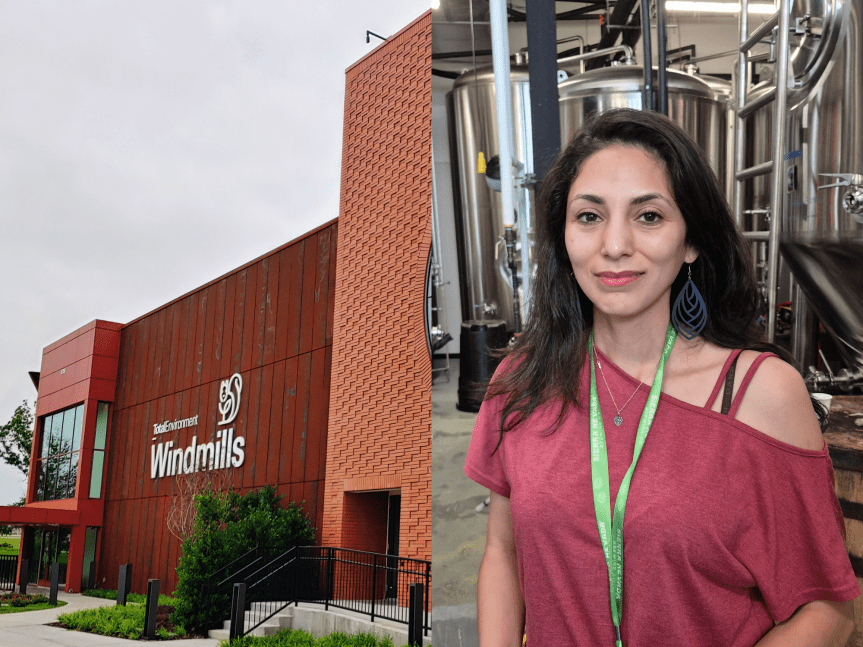
Hernandez was hired at Windmills in The Colony in June 2024, working there under Marcus Baskerville (formerly of San Antonio’s Weathered Souls Brewing, closed in September that same year). She was recently elevated to head brewer at the Indian-styled suburban brewpub, restaurant and world music venue, which has just recently opened a sister location in Hyderabad. Hernandez presently runs the brewhouse by herself after eight years in the Texas craft brewing industry with a resume that includes Blazing Tree Brewing in El Paso and Celis Brewing and Nomadic Beerworks in Austin.
Diana is a strong-willed, wiry Hispanic woman originally from El Paso, herself a product of the dual cross-border cultures there as are many residents. She graduated from New Mexico State University with a degree in microbiology and chemistry, which already makes her an outlier for her demographic. “I had every intention to be a veterinarian. I love science… I’m really good. I like math… I wanted to take care of animals. And then somebody,” as many good stories begin, “my good friend from El Paso, was the manager of a brewery…”
Taking a summer break after graduation and before applying to Texas A&M‘s veterinary school, Hernandez filled in for an absent server at Blazing Tree Brewing one summer, which eventually led to an invitation into the brewhouse. “‘So Diana, my cousin is ruining all the beer,'” said her manager. “‘Would you like to come brew with us, back there?’ And I was like, I don’t know how to brew.” She was not unfamiliar with craft beer nor the hobby (“at NMSU, almost everyone used to homebrew”), although it was one she had never formally picked up. Oddly enough, what convinced the manager to invite her to learn to brew was the time they spent together in high school welding classes. Turns out that Hernandez has a wealth of practical and industrial skills.
El Paso is by its nature and geography a secluded town. The nearest cities of any note are Las Cruces and Odessa/Midland, none of which are large or modern urban centers. The San Antonio metro area is more than 500 miles distant; Phoenix, Arizona, is closer. Not until a trip visiting family in San Diego was Hernandez exposed to more than the three close-knit craft brewing operations local to El Paso at the time. “They have a a small craft beer culture down there that’s kind of unique to the Valley,” says Hernandez. “So it’s all sort of self-enclosed. Everybody knows each other. They don’t get a lot of exposure to the rest of the state. Nothing except big ones come in,” referring to brewery distribution and commercial representation.
But her friend’s invitation was enough for Hernandez to consider brewing professionally as a viable career, especially after three years on staff and working her way to head brewer. She was later recruited to Celis Brewing by Daytona Camp (granddaughter of the legendary Pierre Celis) via a mutual friend, and eventually made her way to North Texas with her present position at Windmills. Along the way, scholarships to White Labs and the Pink Boots Society national conference in New Orleans expanded her skillset and professional network and cemented her experience. “I went to White Labs to learn more about yeast counting… So I was familiar with that for a year and a half. But it was just nice to see from textbook, from actual life, just to see if I missed anything.”
“I never went back [for] schooling or anything,” says Hernandez. “I just bought a whole bunch of books. I have a whole little library for it.” By this point, her professional education and training became largely self-guided as she shadowed other brewers while at work. “I always would just be, ‘Hey, why does this happen? Why the salt? Why the calcium? Why the gypsum?’ I just wanted to know everything… I don’t want to feel embarrassed when somebody asked me. So it’s just like I try over-learning it, just in case somebody asked.”
Her professional brewing philosophy developed to be as realistic as her education, with a basis in the practical rather than theory: “I do not want to pour anything that I personally don’t even like. If I don’t like it, it’s just not up to standard… the beer has to be clean and has to be good. If it didn’t turn out… I’m not pouring that at all.”
The move from El Paso to the burgeoning Austin area brought more than just a minor culture shock. The craft beer culture along border towns is unsurprisingly largely Latino, and El Paso’s relative isolation created a close brewing “bubble” where everyone knew everyone else and support came naturally. Austin, however, was something different: “But going into Austin, into the brewing community, which was my first exposure to… a huge brewery, and I felt the competitiveness… [as] if they didn’t want to teach me, they didn’t want to show me anything, and it’s just like, ‘What are you afraid of?’ When you feel secure in what you know, you teach other people, that’s what you do.”
Was this due to being female, or just an outsider on a big team for the first time? Was it part of the state’s greater craft brewing culture or due to the politics of that specific business as it experienced some heavy corporate reorganization at the same time, and the related stresses felt by nervous employees? Difficult to say: “I just think that they didn’t really want to teach me anything… They didn’t take me very seriously. It was just a very, very odd culture.” Whatever the reasons, Hernandez continued to watch and learn as much as she could in an industry recognized for very few women in her position.
“I don’t think it’s bad,” she adds. “It almost feels that as a woman, I just have to [have] ‘double proof’… because I’m not to be believed… You know, I can’t just say something because I know it’s a fact. Now I’ve got to bring up proof.” Unfortunately, Hernandez feels her ethnicity might also play a part in such attitudes. “This is going to sound silly, but for a white woman in the brewhouse, it might be even easier for her to [get] some points across, and they might be believed a little more. But for me, [they say] ‘you don’t know what you’re talking about, you have no idea what you’re talking about.'”
“I’ve been in the industry for eight years. I’ve worked with four different brew systems. I’ve done distribution and non-distribution [brewing]. I’ve done a variety of things in order to make my resume very strong. And even after eight years, I’m still doubted.” That is somewhat of a mic-drop statement regarding the state’s craft brewing industry.
Fortunately, her experience in the Dallas/Fort Worth area has been better overall but still with its own subculture subtleties. Hernandez uses words like welcoming and sweet but also alienating and disconnected to describe it, mostly based on the sprawling distances between breweries and between home and work for most people. “You know, the guys won’t hang out with me… they just don’t [ever] hang out. Everyone just goes home… That in Austin, anyone that you would ask is, ‘Yeah, let’s go get a beer anytime.’ But the culture up here in North Texas feels like nobody really gets a shift* after work. They just go straight home. It is more suburban-based.”
Such new lifestyle limitations have even affected her hobbies, to a degree. “I play guitar, and right now, my current obsession is trying to learn the drums.” She managed to acquire a drum set for her brother back in El Paso, which she now has at her apartment in Fort Worth. “I’m obsessed with heading home and playing before 10 pm, even if it’s just 20 minutes. That way I don’t disturb anyone. Noise ordinance says I can’t play past 10 pm. I love doing that.” PH
* By tradition, most breweries give a free “shift beer” to employees as a courtesy to enjoy after their work day ends.
 North Texas Beer Blog