One aspect of modern craft beer that is too often overlooked in this space is the rich depth and variety of Belgian beer styles. With a focus primarily on the breweries of the North Texas region, these beers are missed as no locals are fully “of the Belgian tradition” and too few of them attempt the demanding and complex classic styles that can be a challenge to sell to locals.
That oversight is a disservice to the readers here. As a stylistic category, Belgian brewers are known as rule-breakers, not bound by the often restrictive brewing heritage and conventions of other European countries. The beers they have produced for centuries, including those by Trappist monks, are often more yeast-forward and unafraid of fruit and other adjuncts, and can often defy more narrow flavor classifications. Some house yeast strains have been distinctly cultivated for centuries, and wild (natural) fermentation is also embraced for sometimes unexpected and unrepeatable results.
So when Shawn Howell, a long-time Forth Worth craft bar manager and local craft beer majordomo, decided to host a Belgian Beer Dinner this month at Southside Cellar, I jumped at the chance for both the beers and the venue. Southside Cellar opened as a craft beer and wine bar and bottle shop in 2020 on the city’s revitalized South Main (“Near Southside“) district, and has become a strong local rival to the downtown’s original Flying Saucer for the most significant curated craft beer scene in the area.
The multicourse meal was prepared in conjunction with and hosted by Collin Zreet of Priory, a self-proclaimed “ghost brewery” enterprise that collaborates on specialized brewing and custom events such as this. Zreet himself is one of our state’s rare Advanced Cicerones and a former owner of Funky Picnic Brewery & Cafe, which once operated just down the street (closed in 2024).
The casual, communal evening proceeded with some astonishingly good food and beverage pairings:
- Appetizer of cheese slices with aged Gouda and Tomme de Savoie served with fresh baguette slices and paired with Drie Fonteinen Oude Kriek, a malty, tart cherry beer.
- Salad of little gem lettuce with buttermilk dressing, radishes and chicharrón paired with Peticolas On My Way, an easy-drinking, amber table beer called a patersbier.
- A grilled sardine with panko and Parmesan, oregano and mint dressing paired with Tripel Karmeliet, a strong golden sweet ale that packs quite a punch.
- Pork rillette, malt vinegar shallots, and cornichons with stone ground mustard and slices of toasted rye and durum sourdough paired with Orval, an iconic dark-brown Trappist beer with a unique depth and flavor profile.
- For dessert, dried apricots dipped in dark chocolate with pink peppercorns, mascarpone and honey paired with Cantillon Saint Lamvinus, a blended, barrel-aged lambic with an incredible complexity of fruit, malt and funk.
Entire books have been devoted to defining and describing Belgian beer styles, and attempting to recreate it here would be fruitless. The highlights: Abbey beers tend to be strong amber ales but can range from brown Trappist dubbels to brilliantly clear golden tripels to the potent dark quadruppels, each with increasing ABV and complexity. Lambics are tart, wild beers that may have sweet fruit additions and rank among the world’s oldest produced styles, with some aged and blended for surprising flavors effects that can be described as “funky,” “sour” or “barnyard.”
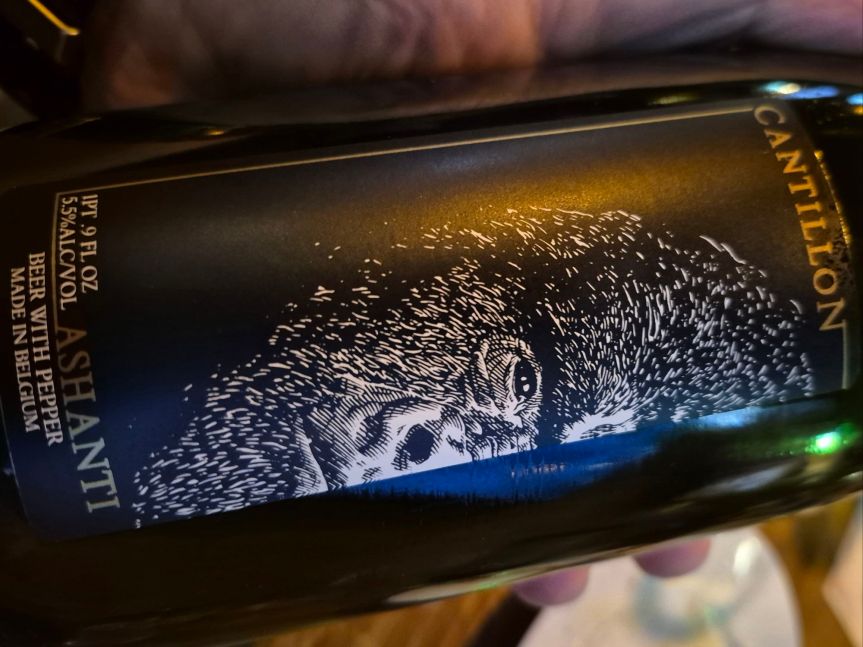
After dinner, a raffle was held, prizes were won and a bottle of Cantillon Ashanti was passed around, a light-bodied and surprisingly enjoyable blonde beer brewed with black peppercorns.
The breweries featured here were all imports (with one exception), and many with impressive pedigrees within the craft beer community—although most predate the current US movement by decades if not a century or more. Tripel Karmeliet and Orval have been in Texas almost since the beginning (1980s?), benefitting from more favorable international distribution, but bottles from breweries like Brouwerij Drie Fonteinen and Brouwerij Cantillon are newly arrived white whales direct from the Zenne Valley that are very authentic, highly desired and often difficult to find at retail in Texas.
As alluded to earlier, few North Texas breweries have embraced Belgian styles or brewing philosophy to any significant degree beyond occasional experimentation. Of course, Garland’s Lakewood Brewing was founded by Wim Bens (a Belgian native) and has produced “Belgian-influenced” styles through the years but lately has drifted toward more popular modern American beers. Peticolas Brewing of Dallas is known more for their English-styled beers but they brewed this event’s lone domestic pairing with their patersbier, a type of mild session beer made for the Belgian dinner table. Peticolas did recently win a bronze medal for their beer Room for More, a Belgian-style dubbel, at last year’s Great American Beer Festival, so perhaps they are flexing their Continental brewing muscles more often.
Howell pivoted Southside Cellar away from his original concept of retail bottle shop to more of neighborhood pub just a couple of years ago, and has recently pivoted once again by adding an in-house pizza kitchen with chef Ben Walter, who was responsible for the food at this event. More beer-pairing events are in the works, and early reports are that the pizza may rank among the best Funkytown has to offer. Watch this place. PH
 North Texas Beer Blog